


Introduction:
Why UPS Maintenance Matters for Business Continuity
Businesses depend on a reliable power supply to keep their operations running without interruption. From manufacturing plants and hospitals to commercial offices, IT infrastructure, and data centers, even a brief power disruption can affect productivity, damage sensitive equipment, and increase operating costs.
A UPS (Uninterruptible Power Supply) protects critical equipment against power interruptions, voltage fluctuations, and other electrical disturbances. However, installing a UPS is only the first step. Regular maintenance, battery inspections, performance testing, and timely repairs are essential to ensure that the system performs when it is needed most.
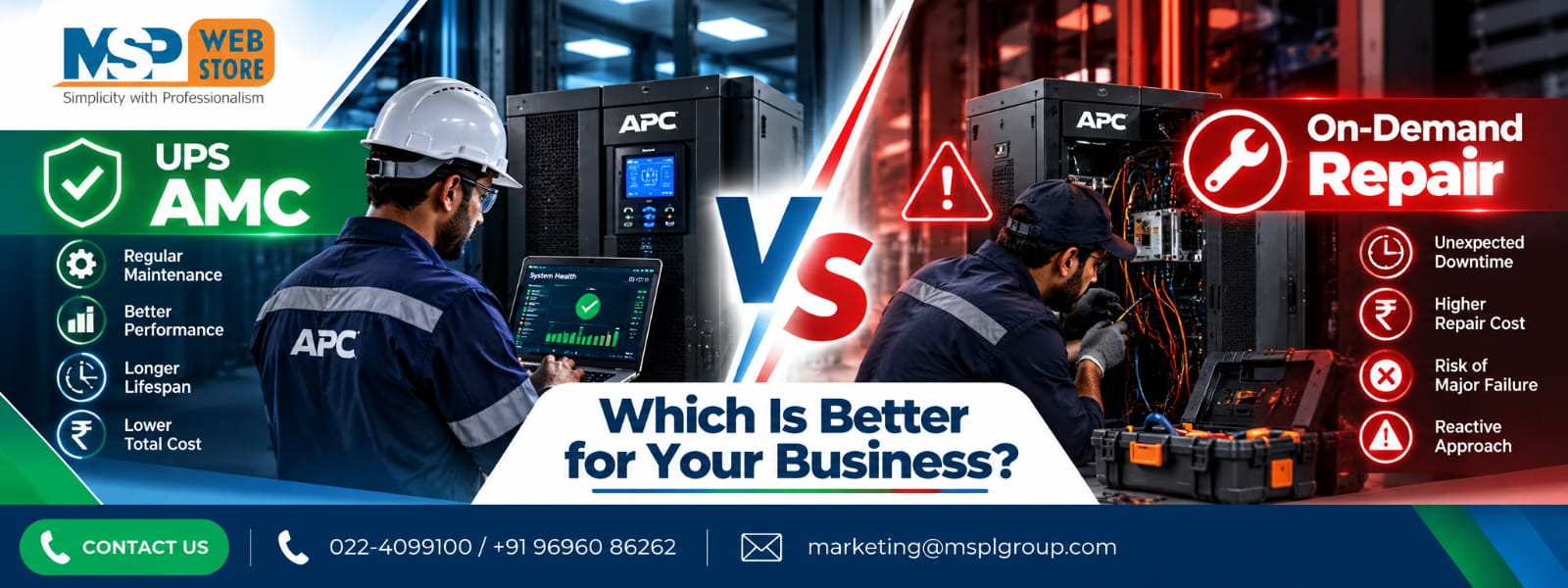
This is where businesses face an important decision: should they invest in a UPS Annual Maintenance Contract (AMC), or pay for on-demand UPS repair whenever a problem occurs?
Both options have advantages. An AMC generally focuses on planned maintenance and service support, while on-demand repair addresses specific faults when they arise. The right choice depends on your UPS capacity, operating environment, equipment criticality, maintenance budget, and acceptable downtime.
MSPL Group helps businesses evaluate UPS maintenance requirements and power backup solutions according to their operational needs. This guide explains the differences between UPS AMC and on-demand repair, their costs, benefits, limitations, and suitability for different industries.
1. What Is a UPS Annual Maintenance Contract (AMC)?
A UPS Annual Maintenance Contract is a service agreement between a business and a UPS service provider for maintenance and support over a defined period, commonly one year.
Depending on the selected plan, a UPS AMC may include scheduled inspections, preventive maintenance, system health checks, fault diagnosis, and technical support.
Businesses can choose between different service arrangements based on their operational requirements.
Types of UPS AMC Services
- Comprehensive AMC: May include preventive maintenance, repairs, labour, and specified replacement parts, subject to the contract terms.
- Non-comprehensive AMC: Typically covers scheduled maintenance and specified service support, while spare parts and certain repairs are billed separately.
- Preventive maintenance contract: Focuses on regular inspections, testing, and identifying potential problems before they cause failure.
Before signing an annual UPS maintenance contract, businesses should confirm the number of visits, response time, emergency support availability, exclusions, battery coverage, spare-parts policy, and applicable charges.
An AMC should provide a clearly defined maintenance plan rather than an assumption that every repair or replacement is automatically covered.
2. What Is On-Demand UPS Repair?
On-demand UPS repair is a service model in which a business contacts a technician when its UPS develops a fault or stops working correctly.
Instead of paying for a recurring maintenance contract, the business pays for the service required at that time.
Typical on-demand UPS repair services include:
- UPS fault diagnosis and troubleshooting.
- Repair of faulty electronic components.
- Battery testing and replacement recommendations.
- Cooling fan and ventilation-related repairs.
- Inverter, rectifier, and charger fault investigation.
- Alarm, overload, and bypass-related troubleshooting.
- Emergency UPS repair following an unexpected breakdown.
This model may work well for smaller businesses with non-critical equipment or backup systems that can tolerate occasional downtime.
However, on-demand repair is primarily reactive. If a battery deteriorates gradually or a cooling problem remains unnoticed, the first clear indication may occur when the UPS fails to provide the expected backup.
Service availability, technician response times, and spare-parts availability can also influence the total cost of a breakdown.
3. UPS AMC vs On-Demand Repair: Key Differences
The most important difference is the approach to maintenance. AMC generally provides planned service under an agreed contract, while on-demand repair responds to individual faults.
| Comparison factor | UPS AMC | On-demand repair |
| Maintenance approach | Planned and preventive, depending on plan | Primarily reactive |
| Payment structure | Fixed contract fee for defined services | Charges per service call or repair |
| Scheduled inspections | Usually included as specified | Generally not included automatically |
| Emergency support | Depends on agreed service terms | Depends on technician availability |
| Repair costs | Coverage depends on contract type | Charged for each repair |
| Spare parts | Included only when specified | Generally billed separately |
| Budget planning | More predictable for covered services | Costs can vary significantly |
| Downtime prevention | Helps identify developing issues | Usually starts after a problem occurs |
| Best suited for | Critical systems and regular operations | Less-critical or occasional-use systems |
Important: An AMC does not guarantee zero downtime. Its effectiveness depends on the service agreement, maintenance quality, equipment condition, and the availability of suitable replacement parts.
4. How Does UPS AMC Reduce Downtime Risk?
UPS failures are not always sudden. Battery ageing, loose connections, blocked airflow, excessive temperatures, and component deterioration can gradually reduce system reliability.
A well-designed preventive maintenance programme helps identify these warning signs before they develop into more serious problems.
For example, a technician may identify declining battery performance during an inspection. The business can then schedule replacement before the batteries fail during a power outage.
Similarly, inspection of cooling systems and electrical connections can reveal issues that may otherwise remain unnoticed.
UPS AMC can help businesses:
- Identify potential equipment faults earlier.
- Monitor battery condition and backup performance.
- Plan repairs during suitable maintenance windows.
- Reduce unexpected service interruptions.
- Maintain service records for better maintenance decisions.
- Improve the visibility of future maintenance requirements.
For operations where every minute matters, these preventive measures can be more valuable than simply reducing the initial maintenance expenditure.
5. Benefits of UPS AMC Services for Businesses
A UPS AMC can provide several operational and financial benefits when its coverage matches the business's requirements.
Predictable Maintenance Budget
A defined annual fee helps businesses plan maintenance expenditure for services included in the contract. This can simplify budgeting compared with unpredictable repair bills.
Regular Equipment Inspections
Scheduled maintenance provides opportunities to identify developing faults, inspect critical components, and review system performance.
Access to Technical Expertise
Depending on the agreement, businesses may receive support from technicians familiar with UPS systems, batteries, and associated power infrastructure.
Better Maintenance Planning
Planned service visits can be coordinated with production schedules, office hours, or approved maintenance windows.
Improved Equipment Reliability
Routine servicing can help maintain UPS performance, although equipment lifespan also depends on operating conditions, design, loading, and component quality.
For businesses using high-capacity, online, or three-phase UPS systems, structured maintenance is particularly important because the consequences of a failure may extend beyond a single workstation or device.
6. Advantages and Limitations of On-Demand UPS Repair
On-demand repair is not necessarily the wrong choice. It can be a practical option when equipment is less critical and the business can manage occasional service interruptions.
Advantages
- No recurring annual contract fee.
- Payment only when service is required.
- Flexibility to request repair support as needed.
- Potentially lower maintenance expenditure for systems with infrequent faults.
- Suitable for certain backup units used in low-risk applications.
Limitations
- Unexpected repair expenses can disrupt budgets.
- Preventive inspections may be overlooked.
- Emergency support may not always be immediately available.
- Spare-parts procurement can extend downtime.
- Repeated faults may lead to higher cumulative costs.
Consider a small office where a secondary UPS supports non-essential equipment. If a failure does not interrupt customer service or business-critical applications, on-demand repair may be reasonable.
However, the same approach can be risky for a production facility where a UPS problem affects control systems or essential automation equipment.
7. UPS AMC vs On-Demand Repair: Which Is More Cost-Effective?
The cheapest maintenance option is not always the one with the lowest initial price. Businesses should compare the total annual cost, including service fees, replacement parts, downtime, emergency response, and operational losses.
The following example uses illustrative figures, not actual MSPL Group quotations or industry-wide average prices.
| Annual cost component | UPS AMC | On-demand repair |
| Annual service expenditure | ₹30,000 | ₹0 |
| Repair labour and call-outs | ₹5,000 | ₹15,000 |
| Spare parts and consumables | ₹10,000 | ₹15,000 |
| Downtime-related losses | ₹10,000 | ₹40,000 |
| Total annual cost | ₹55,000 | ₹70,000 |
In this example, the AMC option costs ₹15,000 less over the year.
Actual results can be very different. A comprehensive AMC may cost more, and expensive replacement batteries or excluded components can increase costs under either arrangement.
The key is to compare equivalent coverage and include the financial impact of downtime.
How to Calculate Your UPS Maintenance ROI
Businesses can estimate the return on investment using:
Annual net benefit = Total expected cost without AMC − Total expected cost with AMC
ROI (%) = (Annual net benefit ÷ Annual AMC cost) × 100
For example, if an AMC costs ₹30,000 annually and reduces total expected repair and downtime expenditure by ₹45,000, the net benefit is ₹15,000.
The resulting ROI is 50%.
These figures are illustrative. Businesses should calculate their own estimates using historical failures, service quotations, production losses, and contract exclusions.
8. The Hidden Cost of UPS Downtime
The cost of a UPS failure extends beyond repairing the equipment. Depending on the application, a power-related interruption can affect staff productivity, customer transactions, production schedules, data availability, and equipment safety.
Potential downtime costs include:
- Lost production and delayed orders.
- Interrupted business applications.
- Lost staff productivity.
- Missed service commitments.
- Data or transaction recovery expenses.
- Emergency technician and logistics charges.
- Damage to customer confidence.
For example, if an operation loses ₹20,000 in contribution for every hour of downtime, a three-hour interruption represents ₹60,000 in potential lost contribution.
If a preventive maintenance programme reduces the likelihood or duration of such interruptions, its financial value may substantially exceed the direct cost of servicing.
However, avoided downtime is an estimate rather than a guaranteed saving. Businesses should use realistic failure probabilities and documented operating costs when making investment decisions.
9. Which Industries Benefit Most from UPS AMC?
The importance of preventive maintenance varies by industry, depending on the criticality of the equipment supported by the UPS.
Manufacturing and Industrial Plants
Manufacturing facilities may use UPS systems for PLCs, industrial automation, control panels, monitoring systems, and essential production infrastructure.
A failure can interrupt a production sequence or require time-consuming equipment recovery. Industrial UPS maintenance can help identify developing problems and support planned servicing.
Data Centers and Server Rooms
Data centers require reliable power protection for servers, network equipment, storage systems, and supporting infrastructure.
Businesses should consider scheduled UPS maintenance, battery monitoring, bypass arrangements, redundancy, and service response commitments. AMC is particularly valuable when a failure could affect multiple customers or business applications.
Hospitals and Healthcare Facilities
Hospitals may rely on UPS systems for essential IT infrastructure, diagnostic equipment, and other designated critical loads.
Maintenance schedules should be coordinated with facility safety procedures and applicable requirements. UPS maintenance must complement, not replace, appropriate emergency power systems.
Commercial Offices and IT Businesses
Offices use UPS systems to protect computers, networking equipment, communication systems, and business applications.
An AMC may be useful where a large number of users depend on uninterrupted IT services. Smaller offices with limited critical loads may find on-demand service sufficient.
Pharmaceutical and Process Industries
Pharmaceutical production and process facilities may use sensitive monitoring, automation, and control systems.
A suitable maintenance programme can support equipment reliability and help businesses plan servicing without unnecessarily disrupting operations.
10. UPS AMC for Small Businesses vs Large Enterprises
Business size can influence the maintenance decision, but the criticality of the connected equipment is often more important than company size alone.
| Business type | Suggested approach | Reason |
| Small office | AMC or on-demand repair | Depends on IT dependency and downtime tolerance |
| Retail outlet | Risk-based maintenance | Depends on billing and payment system criticality |
| Manufacturing plant | Preventive AMC often worth considering | Production interruptions may be expensive |
| Data center | Structured maintenance and support | High availability requirements |
| Hospital | Criticality-based maintenance programme | Essential equipment requires dependable support |
| Multi-site enterprise | Standardized maintenance agreements | Consistent service planning across locations |
For a small business, a UPS supporting its only billing system may be more critical than a much larger UPS serving non-essential equipment.
Assess the consequences of failure before selecting a maintenance plan.
11. What Should a Good UPS AMC Include?
Before choosing a UPS maintenance contract, businesses should verify the actual services offered rather than relying on the AMC label alone.
A practical UPS AMC checklist includes:
- Number and frequency of preventive maintenance visits.
- UPS inspection and operational testing.
- Battery condition assessment and replacement recommendations.
- Inspection of cooling fans and ventilation.
- Review of alarms, operating logs, and fault history.
- Inspection of electrical connections, where safely applicable.
- Labour and repair coverage.
- Spare-parts and consumables policy.
- Emergency service availability.
- Guaranteed or target response times, as specified in writing.
- Service reports and maintenance documentation.
- Contract exclusions, taxes, and renewal terms.
For industrial UPS systems and high-capacity online UPS equipment, businesses should also confirm technician qualifications and compatibility with the specific model.
Battery replacement should be discussed separately unless it is explicitly included in the contract. Batteries are consumable components, and their replacement cost can materially affect the overall maintenance budget.
12. Warning Signs Your UPS Needs Professional Maintenance
Regardless of whether your business has an AMC, certain warning signs require prompt attention.
Look out for:
- Frequent UPS alarms or unexplained fault codes.
- Reduced battery backup time.
- Unexpected transfer to bypass mode.
- Repeated overload warnings.
- Unusual fan noise or excessive heat.
- Swollen, leaking, or visibly damaged batteries.
- Recurring faults after previous repairs.
Damaged batteries, smoke, burning smells, or signs of overheating require appropriate safety precautions and professional assistance. Do not open live electrical equipment or attempt unsafe repairs.
If a UPS repeatedly develops faults, consider whether the problem reflects ageing components, unsuitable capacity, environmental conditions, or an underlying power-quality issue.
13. How to Choose the Right UPS Maintenance Plan
Choosing between AMC and on-demand repair starts with an assessment of your power backup requirements.
Step 1: Identify critical loads. Determine which equipment must remain operational during power interruptions.
Step 2: Assess downtime impact. Estimate the financial and operational consequences of a UPS failure.
Step 3: Review equipment condition. Consider the UPS age, battery health, fault history, operating environment, and maintenance records.
Step 4: Compare service agreements. Review AMC pricing, preventive visits, emergency support, exclusions, and spare-parts coverage.
Step 5: Evaluate service capability. Confirm whether the provider supports your UPS model, capacity, location, and technical requirements.
Step 6: Review the decision annually. Update your maintenance strategy when business operations, equipment loads, or risk levels change.
Businesses should also consider redundancy. A well-designed redundant UPS arrangement can reduce the consequences of an individual equipment failure, but redundancy itself requires appropriate maintenance and periodic testing.
14. Preventive Maintenance vs Breakdown Maintenance
Preventive maintenance and breakdown maintenance represent two different approaches to equipment reliability.
Preventive maintenance follows a planned schedule to identify issues and maintain equipment before a failure occurs. Breakdown maintenance is performed after a fault has developed.
For critical UPS infrastructure, preventive maintenance can provide better visibility into battery condition, component wear, and developing faults.
Breakdown maintenance can be appropriate for low-criticality equipment when the consequences of failure are limited and the business accepts the associated risk.
A balanced maintenance strategy may include scheduled inspections, condition-based battery replacement, emergency repair arrangements, and periodic review of UPS capacity.
The objective is not to service every component unnecessarily. It is to perform the right maintenance at the right time to support reliability and control lifecycle costs.
15. How MSPL Group Supports Business Power Reliability
MSPL Group, also known as Mahavir Sys-Power Pvt. Ltd., provides UPS and power backup solutions for businesses with different operational requirements.
Selecting an appropriate maintenance arrangement involves more than comparing AMC fees. Businesses need to understand the UPS model, connected load, battery condition, installation environment, service requirements, and acceptable downtime.
MSPL Group can help businesses evaluate relevant UPS service and power backup requirements, including maintenance planning, repair support, battery-related requirements, and equipment selection, according to the services available for the specific system.
Whether you operate a commercial office, manufacturing unit, server room, or industrial facility, a structured assessment can help identify maintenance priorities and potential reliability risks.
Looking for UPS AMC or professional UPS repair support? Contact MSPL Group to discuss your UPS infrastructure, maintenance requirements, and suitable service options.
Call: +91 08048128715
Website: msplgroup.com
Ask for a maintenance assessment to understand which services are appropriate for your UPS system and business operations.
16. Common Mistakes Businesses Should Avoid
Businesses can reduce maintenance-related risks by avoiding these common mistakes:
- Choosing a service provider based only on the lowest AMC price.
- Assuming every AMC includes batteries and spare parts.
- Ignoring recurring alarms because the UPS still operates.
- Delaying battery replacement despite poor backup performance.
- Failing to check emergency response commitments.
- Skipping maintenance records and inspection reports.
- Assuming an AMC guarantees uninterrupted operation.
- Overlooking the cost of downtime when comparing service plans.
A reliable maintenance strategy should balance service cost, equipment condition, operational risk, and the quality of technical support.
17. UPS AMC vs On-Demand Repair: Final Decision Guide
For businesses that rely on continuous power protection, a UPS AMC is often worth considering because it supports scheduled maintenance and more predictable service expenditure.
On-demand repair may be more suitable when equipment is non-critical, failures are infrequent, and the business can tolerate interruptions while arranging repairs.
The right decision should be based on the total cost of ownership rather than the annual service fee alone. Consider repair history, battery condition, downtime losses, service response times, and contract coverage before making a commitment.
For data centers, industrial plants, hospitals, and other critical operations, a documented preventive maintenance strategy is generally a stronger starting point than waiting for equipment to fail.
MSPL Group can help you assess your UPS maintenance needs and explore suitable power backup service options for your business. Invest in a maintenance strategy that supports reliability, protects critical equipment, and helps control avoidable downtime.
FAQs
1. What is the difference between UPS AMC and on-demand repair?
A UPS AMC is a maintenance agreement that generally includes scheduled servicing and specified support over a defined period. On-demand repair is requested when a fault occurs, with charges based on the service provided.
2. Is a UPS AMC worth it for a small business?
It can be worthwhile if the UPS protects essential computers, billing systems, servers, or communication equipment. If the supported equipment is non-critical and downtime has minimal impact, on-demand repair may be sufficient.
3. What is included in a UPS annual maintenance contract?
Depending on the agreement, it may include preventive inspections, performance checks, fault diagnosis, labour, and technical support. Battery replacement, spare parts, consumables, and emergency visits must be verified in the contract.
4. How much does UPS AMC cost in India?
UPS AMC costs vary according to UPS capacity, model, age, location, service frequency, and coverage. Comprehensive contracts and agreements for high-capacity systems may cost more than basic maintenance plans. Request a system-specific quotation for accurate pricing.
5. Does UPS AMC include battery replacement?
Not necessarily. Some agreements may include specified batteries or replacement components, but many exclude batteries or charge separately for them. Always check the written coverage and replacement conditions.
6. How often should a UPS be serviced?
The recommended frequency depends on the manufacturer's guidance, UPS model, operating environment, load, battery technology, and application criticality. Many businesses schedule preventive inspections periodically and arrange additional checks when alarms or performance changes occur.
7. Can UPS AMC prevent unexpected power failures?
Preventive maintenance can identify certain developing faults and reduce some failure risks, but it cannot eliminate every failure. Battery ageing, external electrical events, component defects, and other factors can still cause interruptions.
8. Which is better for industrial UPS systems: AMC or on-demand repair?
An AMC with suitable preventive maintenance and clearly defined service support is often preferable for critical industrial applications. The final choice depends on downtime costs, redundancy, service availability, and the contract's scope.
9. How can businesses reduce UPS downtime?
Businesses can reduce downtime risk through scheduled maintenance, battery health checks, correct UPS sizing, suitable operating temperatures, alarm monitoring, documented repair procedures, and appropriate redundancy for critical loads.
10. How can I get UPS AMC or repair services from MSPL Group?
Visit Msplgroup.com or call +91 08048128715 to discuss your UPS maintenance and power backup requirements. Confirm service availability and contract coverage for your particular UPS model and location.
Conclusion
Choosing the right UPS maintenance strategy can make a significant difference in business continuity, equipment reliability, and operating costs. While on-demand repair may seem economical initially, unexpected breakdowns and emergency repair expenses can increase overall costs. A well-planned UPS AMC helps businesses identify potential issues early, maintain battery health, and reduce downtime risks.
For manufacturing plants, data centers, hospitals, and commercial offices, preventive maintenance is an important investment in reliable power infrastructure. MSPL Group offers UPS and power backup solutions to help businesses maintain operational reliability and protect critical equipment.
Need expert guidance for your UPS maintenance requirements? Contact MSPL Group at +91 08048128715 or visit msplgroup.com to explore suitable UPS maintenance and repair solutions.

0 Comments
Leave a Reply