


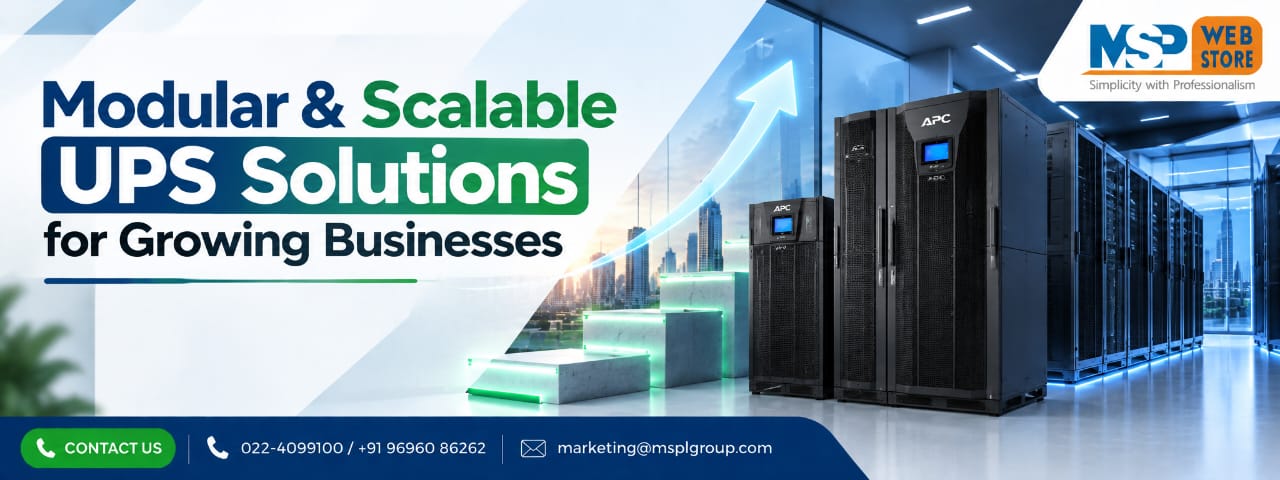
Introduction:
Why Growing Businesses Need Flexible UPS Solutions
Business growth brings new challenges for electrical infrastructure. As companies add servers, production equipment, networking devices, automation systems, data-storage infrastructure, and other critical loads, their power requirements increase. A UPS system that was suitable when a business was smaller may eventually become insufficient or inefficient.
This is where modular and scalable UPS solutions can provide a more flexible approach to power protection. Instead of investing immediately in a large fixed-capacity UPS, businesses can use a modular UPS architecture that allows additional power modules to be added as demand grows.
For organizations operating data centers, manufacturing facilities, healthcare environments, financial services, retail operations, offices, and other critical applications, the right UPS can help protect equipment against power interruptions, voltage fluctuations, electrical disturbances, and unexpected downtime.
A properly designed scalable UPS system can also support business expansion while helping organizations manage capital expenditure, operating costs, efficiency, redundancy, and future capacity requirements.
MSPL Group helps businesses evaluate UPS capacity, redundancy, installation, maintenance, and expansion requirements so that power protection can evolve alongside business growth.
What Is a Modular UPS System?
A modular UPS system consists of multiple power modules that work together within a common UPS architecture.
Unlike a conventional fixed-capacity UPS, where the complete system is generally installed at once, modular UPS systems can be configured around individual power modules.
For example, a business might initially require 100 kW of protected capacity. Instead of installing a much larger fixed system immediately, it can deploy a modular configuration and add modules as its electrical load increases.
This architecture can offer:
- Flexible capacity expansion
- Easier maintenance
- Improved redundancy options
- Better space utilization
- Potentially improved efficiency at appropriate loads
- Simplified future planning
The exact benefits depend on the UPS topology, manufacturer, load profile, redundancy configuration, and installation design.
What Are Scalable UPS Solutions?
Scalable UPS solutions are designed to allow backup capacity to increase as an organization's power requirements change.
Business requirements rarely remain constant. A data center may add racks, a factory may install new machinery, and an office may expand its IT infrastructure.
With a scalable UPS system, businesses can plan capacity in stages.
Example
A growing organization may have the following requirements:
| Business Stage | Required UPS Capacity |
| Initial operation | 100 kVA |
| Expansion 1 | 150 kVA |
| Expansion 2 | 200 kVA |
| Future requirement | 300 kVA |
Instead of purchasing the final capacity on day one, the organization can evaluate a modular architecture that supports progressive expansion.
This approach can help align infrastructure investment with actual business growth.
Modular UPS vs Traditional Fixed-Capacity UPS
The choice between modular and conventional UPS systems depends on the application's requirements.
| Feature | Modular UPS | Traditional Fixed UPS |
| Capacity expansion | Generally easier | May require major replacement or parallel systems |
| Initial investment | Can be phased | Often larger upfront investment |
| Redundancy | Flexible configurations | Depends on system architecture |
| Maintenance | Modules can simplify servicing | May require more extensive intervention |
| Space utilization | Often compact | Depends on design |
| Future planning | Highly adaptable | Requires more accurate forecasting |
| Suitable applications | Growing/critical loads | Stable and predictable loads |
Neither architecture is automatically suitable for every application. Load characteristics, required uptime, available space, budget, redundancy requirements, and future expansion plans should all be considered.
4. Why Growing Businesses Need Scalable Power Backup
Power requirements can increase quickly when a company expands.
A growing business may introduce:
- Additional servers
- Cloud and networking infrastructure
- Automated machinery
- Production lines
- Security systems
- HVAC equipment
- Laboratory equipment
- Point-of-sale systems
- Storage infrastructure
- AI and high-performance computing workloads
Installing a UPS that only meets today's requirements can create limitations later.
A scalable UPS system allows businesses to consider future requirements during the initial design stage.
This can reduce the risk of repeatedly replacing power-protection infrastructure whenever the business expands.
Modular UPS for Data Centers and Server Rooms
Data centers are among the most important applications for modular UPS technology.
Servers, network switches, storage systems, cooling infrastructure, and security systems require stable electrical power. Even a short interruption can potentially cause service disruption or data-processing issues.
A modular data center UPS can be configured around current IT loads while allowing additional capacity as rack density increases.
For example, a growing enterprise data center may begin with several server racks and gradually expand to accommodate additional workloads.
A scalable architecture can help the facility plan:
- Current capacity
- Future IT growth
- N+1 redundancy
- Maintenance requirements
- Load distribution
- Battery autonomy
- Monitoring
- Cooling requirements
UPS sizing should always consider the actual critical load rather than simply estimating capacity from floor area.
Modular UPS for Manufacturing and Industrial Applications
Manufacturing facilities face different power challenges.
Industrial equipment may include PLCs, CNC machines, automation systems, robotics, control systems, instrumentation, servers, and communication equipment.
A suitable industrial UPS can protect sensitive control and automation equipment from power disturbances.
For a growing factory, modular UPS architecture can be useful when production capacity is being expanded in phases.
Example
A manufacturing company may initially operate one production line and later add two additional lines. Its electrical load therefore increases over time.
A scalable UPS strategy can allow the business to plan backup capacity according to its production expansion rather than purchasing the entire future capacity immediately.
Online UPS and Modular UPS: Understanding the Difference
Online UPS and modular UPS describe different characteristics.
An online UPS, commonly based on double-conversion technology, continuously conditions incoming power and supplies connected equipment through the inverter.
A modular UPS describes an architecture in which power modules can be added, removed, or configured within a scalable system.
Therefore, a UPS can be both:
Modular + Online + Three Phase + Scalable
This combination can be particularly relevant for demanding commercial, industrial, and data-center applications.
When selecting a system, businesses should evaluate topology, capacity, redundancy, efficiency, battery technology, monitoring, and service support rather than focusing on a single specification.
Key Benefits of Modular and Scalable UPS Systems
Businesses consider modular UPS solutions for several reasons.
Flexible Capacity
Additional modules can potentially be introduced as electrical demand increases.
Redundancy
Modular configurations can be designed to provide redundancy, depending on the system architecture.
Maintenance Flexibility
Some systems allow individual modules to be serviced without shutting down the complete protected load when the appropriate redundancy and bypass arrangements are available.
Efficient Infrastructure Planning
Businesses can align UPS investment with changing requirements.
Space Optimization
High-density modular designs can provide significant power capacity within a relatively compact footprint.
Future Expansion
The infrastructure can be designed with growth in mind rather than treating expansion as an afterthought.
UPS Scalability and N+1 Redundancy
Redundancy is an important consideration for critical applications.
In an N+1 configuration, the system includes at least one additional module beyond the number required to support the critical load.
For example, if four modules are required to carry the load, an N+1 configuration could use five modules.
If one module becomes unavailable, the remaining modules can potentially continue supporting the required load, provided the system has been correctly designed and the remaining capacity is sufficient.
The actual redundancy strategy should be determined by a qualified UPS engineer based on load requirements and availability objectives.
Modular UPS Efficiency and Energy Savings
UPS efficiency affects operating costs because electrical losses can translate into heat and energy consumption.
Modern UPS systems may offer high operating efficiency across suitable load ranges. However, actual efficiency depends on:
- UPS model
- Load percentage
- Operating mode
- Input/output conditions
- Temperature
- Battery operation
- System configuration
- Maintenance condition
A scalable architecture can help businesses avoid unnecessarily oversized systems.
For example, installing a very large fixed-capacity UPS for a relatively small current load may result in less efficient operation depending on the equipment and operating conditions.
A properly sized modular system can provide a more adaptable approach.
ROI and Financial Benefits of Scalable UPS Systems
UPS investment should be evaluated beyond the initial purchase price.
A basic ROI analysis can consider:
UPS ROI = Avoided Downtime Costs + Operational Savings + Equipment Protection Benefits − UPS Lifecycle Costs
Potential financial considerations include:
- Reduced downtime exposure
- Lower infrastructure replacement costs
- Energy efficiency
- Phased capital expenditure
- Maintenance costs
- Battery replacement
- Expansion costs
- Equipment protection
Example
Suppose an organization estimates that a critical operational interruption could cost ₹5 lakh in lost productivity and recovery expenses.
If a suitable UPS architecture significantly reduces exposure to such interruptions, the financial value of reliable backup can extend well beyond the equipment's purchase price.
Businesses should calculate ROI using their own downtime costs, operating hours, critical loads, and maintenance expenses rather than relying on generic figures.
Modular UPS vs Oversized UPS: Which Approach Fits Growth?
When businesses anticipate expansion, they commonly consider two approaches:
- Purchase a large UPS based on projected future requirements.
- Deploy a scalable architecture and expand capacity progressively.
| Consideration | Oversized Fixed UPS | Scalable Modular UPS |
| Initial capacity | High | Based on current requirement |
| Expansion | Limited | Designed for expansion |
| Capital deployment | Upfront | Can be phased |
| Future flexibility | Depends on design | Generally high |
| Space | Potentially larger | Often optimized |
| Capacity planning | Forecast-dependent | Growth-oriented |
The appropriate approach depends on the business's expansion plans, budget, criticality, and technical requirements.
How to Choose the Right Modular UPS Capacity
Correct UPS sizing is essential.
Businesses should evaluate:
1. Current Load:
Measure actual critical electrical consumption.
2. Future Growth:
Estimate additional servers, machinery, racks, equipment, or production lines.
3. Power Factor:
Understand both kW and kVA requirements.
4. Redundancy:
Determine whether N, N+1, or another architecture is required.
5. Battery Runtime:
Define the required backup duration.
6. Environmental Conditions:
Consider temperature, ventilation, dust, and installation conditions.
7. Expansion Requirements:
Confirm how much additional capacity the selected UPS architecture can support.
Professional UPS sizing helps prevent both under-capacity and unnecessary oversizing.
Battery Technology and Modular UPS Performance
The battery system is an important part of any UPS installation.
Common options include:
- VRLA batteries
- AGM batteries
- Tubular batteries for certain applications
- Lithium-ion batteries
Battery selection depends on runtime, operating environment, lifecycle expectations, space, maintenance strategy, budget, and UPS compatibility.
Lithium-ion UPS battery systems may provide advantages in certain applications, including reduced footprint and potentially longer service life, but their suitability should be assessed against project requirements and manufacturer specifications.
Regular battery monitoring and maintenance are also important for reliable backup performance.
Smart Monitoring for Scalable UPS Systems
As UPS infrastructure becomes larger, monitoring becomes increasingly valuable.
Modern UPS systems may provide information about:
- Input voltage
- Output voltage
- Load percentage
- Battery condition
- Runtime
- Temperature
- Alarms
- Energy consumption
- Module status
Remote monitoring can help facility teams identify abnormal conditions before they become major operational problems.
For businesses operating multiple locations, centralized UPS monitoring can also simplify infrastructure management.
Industry-Specific Applications of Modular UPS Solutions
Modular and scalable UPS systems can support a wide range of industries.
IT & Data Centers
Protect servers, storage systems, networking equipment, and critical IT infrastructure.
Manufacturing
Support automation, control systems, PLCs, CNC machines, and production processes.
Healthcare
Provide backup power for critical medical and IT equipment where appropriate.
Banking & Financial Services
Protect servers, networking equipment, transaction infrastructure, and communication systems.
Retail
Support point-of-sale systems, networking equipment, security systems, and critical digital infrastructure.
Commercial Buildings
Protect building-management systems, IT infrastructure, security systems, and communication equipment.
Education
Support servers, networking systems, digital learning infrastructure, and administrative IT systems.
Modular UPS Installation and Maintenance
Selecting the correct UPS is only one part of the power-protection strategy.
Professional installation should consider:
- Electrical distribution
- Input/output cabling
- Earthing
- Bypass arrangements
- Battery installation
- Ventilation
- Load balancing
- Protection devices
- Monitoring
- Commissioning
Preventive maintenance should include inspections, battery health checks, alarm review, thermal assessment, electrical measurements, and system testing as appropriate.
A structured UPS AMC and maintenance program can help organizations maintain equipment reliability throughout its operating life.
Why Businesses Should Plan UPS Capacity Before Expansion
UPS planning should ideally happen before new electrical loads are installed.
For example, when a business plans a new server room, production line, or facility expansion, its engineering team can assess:
- Current load
- Future load
- Required autonomy
- Redundancy
- Available electrical infrastructure
- UPS room space
- Cooling
- Battery requirements
- Monitoring
- Maintenance access
This approach helps avoid costly infrastructure changes later.
Need help planning your UPS expansion? Contact MSPL Group for UPS consultation, sizing, installation, and maintenance support.
How MSPL Group Supports Modular UPS Requirements
Businesses looking for modular UPS solutions in India often need more than equipment supply.
MSPL Group can support organizations with UPS-related requirements including:
- UPS consultation
- Load assessment
- UPS sizing
- Online UPS solutions
- Industrial UPS
- Three-phase UPS
- Modular UPS systems
- UPS installation
- UPS maintenance
- Battery replacement
- UPS AMC
- Emergency UPS support
- Data-center power backup
The right solution depends on the site's electrical characteristics and operational requirements.
Speak with an MSPL Group UPS specialist to discuss your current load, future expansion plans, redundancy requirements, and backup runtime.
FAQ
What is a modular UPS?
A modular UPS uses multiple power modules within a scalable architecture. Additional modules can often be added as power requirements increase, subject to the manufacturer's system limits.
What is a scalable UPS system?
A scalable UPS system is designed to allow backup capacity to increase as the electrical load grows.
Is a modular UPS suitable for data centers?
Yes. Modular UPS systems can be used in data centers where scalability, redundancy, efficiency, and maintainability are important design considerations.
Can a modular UPS support industrial equipment?
Yes, depending on the equipment, electrical characteristics, UPS topology, capacity, and required power quality.
What is N+1 UPS redundancy?
N+1 means the UPS system has at least one additional module beyond the number required to support the critical load.
Are modular UPS systems more efficient?
They can operate efficiently when properly sized and configured, but actual efficiency depends on the specific UPS model, load level, operating mode, and installation.
Can UPS capacity be increased later?
Many modular UPS systems are specifically designed for capacity expansion, but the permitted expansion depends on the manufacturer's architecture and installed configuration.
How much UPS capacity does my business need?
UPS capacity should be determined from measured critical load, power factor, future growth, redundancy requirements, and desired operating margin.
What battery is suitable for a modular UPS?
VRLA/AGM and lithium-ion batteries are among the options used with UPS systems. Selection depends on runtime, environment, lifecycle, space, maintenance, and compatibility.
How often should a UPS be maintained?
Maintenance frequency depends on the UPS manufacturer, model, environment, battery technology, and operating conditions. Following the manufacturer's maintenance recommendations is important.
Conclusion:
Build a Power Backup Strategy That Grows With Your Business
Business growth should not require repeatedly replacing power-protection infrastructure.
Modular and scalable UPS solutions provide businesses with a flexible way to plan backup capacity around current requirements while preparing for future expansion. They can be considered for data centers, manufacturing facilities, healthcare organizations, financial services, commercial buildings, retail operations, and other environments where reliable power is important.
The best UPS architecture depends on actual load, future growth, redundancy, runtime, efficiency, space, battery technology, maintenance requirements, and budget.
Instead of selecting a UPS based only on today's electrical demand, businesses can work with qualified power professionals to create a capacity roadmap that supports future requirements.
Planning a new UPS installation or expanding your existing power backup system? Contact MSPL Group for UPS sizing, consultation, installation, maintenance, and scalable power backup solutions.
Phone: +91 08048128715
Website: MSPL GROUP.COM

0 Comments
Leave a Reply